

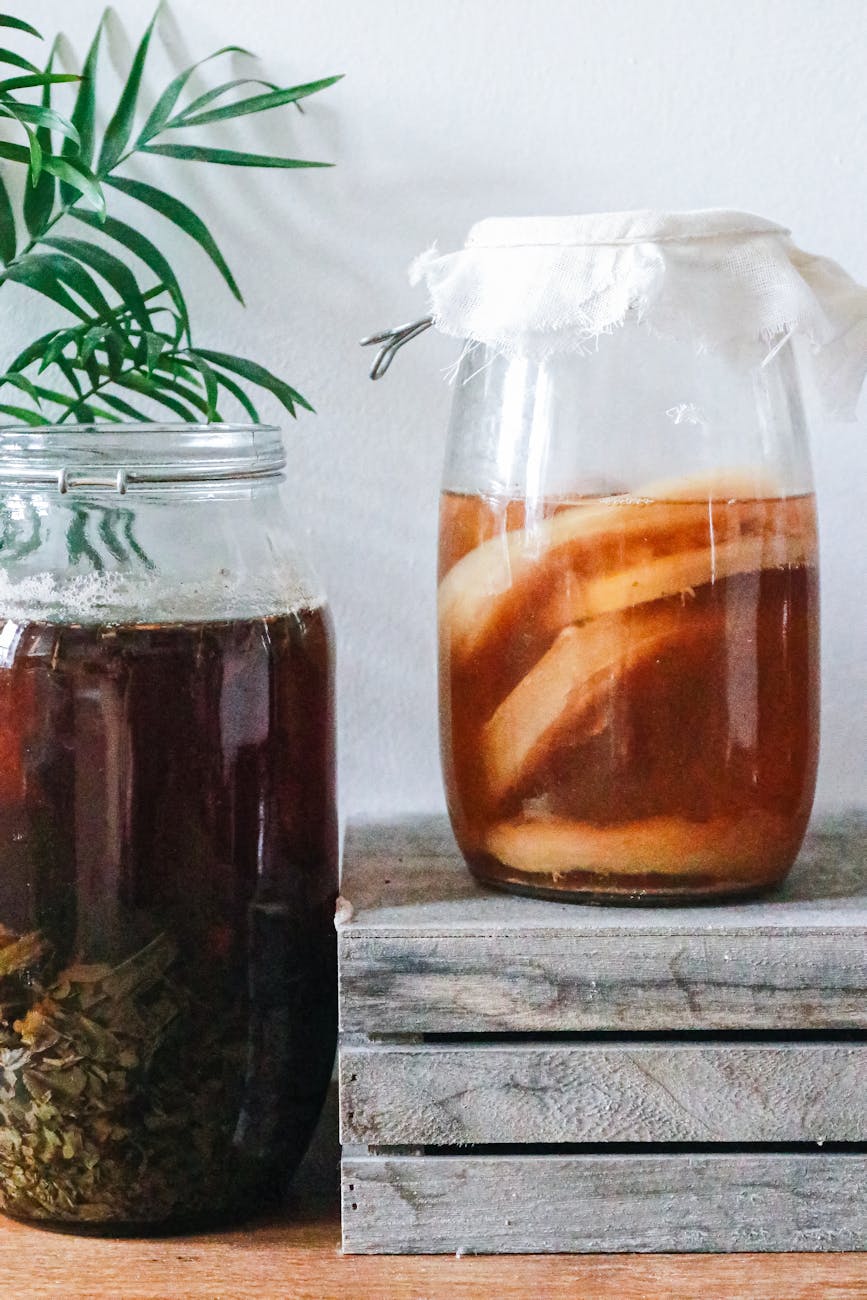
Kombucha has gained popularity in the recent past with a reputation as a health elixir, and people seem to either love or hate its unique taste. It is a bubbly, fermented, probiotic-rich tea that is simple, fun, and beneficial to make in your own kitchen. I have personally been making kombucha for over three years and am delighted to share the process I use with you in this blog post.
What is Kombucha?
If you’re like most of the population, you’ve probably heard of kombucha, and possibly even tried it without knowing what it really is.
Kombucha is a fermented tea beverage made using strongly brewed sweet tea and a starter culture known as a SCOBY, which stands for symbiotic culture of bacteria and yeast. Making kombucha involves two separate fermentations. The initial fermentation stage takes place in a large vessel where sweet tea sits with the SCOBY for several days, exposed to air. During this time, the yeast and bacteria in the mother culture convert the sugar in the sweet tea into acetic acid, creating a beverage with a tart taste, full of beneficial probiotics. The second ferment takes place when the liquid from the initial ferment is sealed in a bottle in combination with fruit or some other form of naturally occurring sugar and allowed to sit for a few more days, which causes carbonation to build and infuses the kombucha with flavor. After this series of fermentations, the kombucha emerges a nicely tart, bubbly, flavorful beverage, ready to be consumed.
Why Should I Make Kombucha at Home?
When you are first learning to brew kombucha at home it may seem overwhelming and complicated, but I assure you that the process is really quite simple and there are many reasons that doing so will be worth your while.
First, one of the main reasons people consume kombucha (aside from the fact that it is a tasty, bubbly, fun beverage to drink) is for its health benefits, most commonly the benefit of gut support which results from the consumption of kombucha’s vast probiotic content. Store bought kombucha, while tasty and easy to access, is not necessarily guaranteed to contain these probiotics, as it may not have been brewed according to traditional kombucha brewing methods. Kombucha sold in stores is often heated for sanitation and preservation purposes, which kills off the naturally occurring probiotics. Some brands will add these back in from synthetic sources after the fact, but these might not carry the same benefits that those occurring naturally do. However, by brewing your own kombucha at home, you can be assured of the quality of your kombucha and the presence of naturally occurring probiotics in your beverage.
Second, brewing kombucha at home is much more economical than supporting a kombucha habit through regular purchase of retail kombucha. Purchasing kombucha is pricey, especially if you are using it as a daily source of probiotics. Brewing kombucha at home, on the other hand, is very affordable, as you can make around 12 servings for the price of a few tea bags and a cup of sugar, which means you can consume it regularly, and reap its benefits, without an added financial burden.
Last, brewing kombucha at home is really very simple, easy, and fun. It uses only a couple of ingredients, requires very little time spent actively involved, and you can work it around your schedule. Once you find a rhythm to incorporate kombucha into your life, you can really spend as much or as little time as you desire experimenting with different flavor profiles and combinations.
What Equipment is Required to Brew Kombucha?
Brewing a fermented beverage may sound complicated and lead you to believe that a plethora of niche items will be required to do so. However, in reality you can decide how simple or complicated you want your brewing process to become.
Before we get into equipment, it is important to be aware that there are several methods for brewing kombucha. The two with which I am familiar are the batch method and the continuous brew method.
Kombucha Brewing Methods
The Batch Method-
This method involves keeping multiple SCOBYs in a large container of previously brewed kombucha, known as a “SCOBY Hotel” and pulling one SCOBY at a time to brew individual smaller sized batches of kombucha. The main advantage of this method is that it allows for greater experimentation in your brewing, specifically in the initial ferment. You can try out a variety of different teas and sugars without affecting your SCOBY culture as a whole, since you have your SCOBY hotel to pull from should an issue arise with any one brew. Some disadvantages of this method are that it requires more involvement with your kombucha, you may not achieve as consistent results, and there is slightly more equipment and storage space required.
The Continuous Brew Method (my preferred method)-
This method involves keeping a singular SCOBY in a large container with a spigot that allows for easy dispensing of your kombucha. The idea is that once you bottle the kombucha from your initial ferment, you would refill the large container to start a new round of fermentation that will be ready for bottling once you have finished drinking the previous round. The main advantage of this method is that you will have a consistent supply of kombucha. Some others are that you can pace your brewing to your preference, that your kombucha brewing will be contained to one large vessel requiring minimal upkeep, and you will have pretty consistent results with each of your brews. This method also allows you to experiment with different teas or sugars if you would like, as you can remove a SCOBY from your continuous brew vessel to add to an experimental batch in a separate container. The main disadvantage would be that you have only one main SCOBY, without backups, should anything go wrong.
Kombucha Brewing Essentials
Must have’s:
- SCOBY – A symbiotic culture of bacteria and yeast is the one necessity to brewing kombucha, as it is the mother. SCOBYs are sold online from a variety of sources. If you obtain one through the internet you will want to confirm that it is of high quality, preferably from an organic brew, and that it comes with at least a couple of cups of starter liquid (which is essentially extra strong kombucha from a previous ferment). Some other ways to obtain a SCOBY locally that I have used in the past are by asking at my local health food store, on the app nextdoor (you could try local facebook groups as well), or getting one from a friend that you know is brewing.
- Two Gallon Glass Jar or Beverage Dispenser – I highly recommend using a large beverage dispenser with a spigot, as this makes bottling much easier than having to remove the SCOBY and pour from a large jar. Your vessel should be made of glass and have a plastic spigot, as metal can have a negative impact on the fermentation process. I have this one (affiliate link) from amazon and have used it for years, but I have had to replace the spigot.
- Organic Caffeinated Tea – I use a mix of plain loose leaf black and green tea (usually English breakfast for black and gunpowder for green) that I source from the bulk section of my local health food store. There are many good sources for tea online, but no matter where you purchase it you want to be sure that your tea is organic, as any chemicals or fertilizers used on inorganic tea can inhibit the proliferation of good bacteria required to support the fermentation process. Black and green tea is my preferred combination for kombucha as it creates a robust flavor and nurtures my SCOBY well. The only other type of tea I have used personally is oolong, which certainly had a more mild flavor. There is no requirement to do so but you are welcome to dive as deep down the rabbit hole of tea experimentation as you wish. Caffeinated tea is required to successfully brew kombucha, but after the fermentation process only a miniscule amount of the original caffeine content remains.
- Organic Cane Sugar – I use organic cane sugar from Costco, as it is the most economical in my area. Once again, you will want to ensure that the sugar you use in your brew is organic, as any sprays or chemicals from inorganic compounds can interfere with the fermentation process. Kombucha may seem to contain a lot of sugar at first glance, but in reality very little of the sugar content remains after the fermentation process occurs, which is evidenced in the shift of flavor from a sweet tea to a tart beverage with only a hint of sweetness remaining.
Optional, but helpful:
- Pressure Rated Flip Top Bottles – Flip top bottles are used for the second stage of fermentation to tightly seal the kombucha so that the gas that is produced as a by-product of fermentation cannot escape and is instead converted to carbonation. It is important that these bottles are able to withstand pressure, as kombucha builds pressure through the carbonation process in the second ferment, and could cause bottle to explode if they are not made of a durable glass. I use these bottles (affiliate link). You do not have to have flip top bottles to make kombucha, but the kombucha does not carbonate very well in regular bottles.
- Water Filter – When making kombucha, it is important to use filtered water so that you do not introduce chlorine or other chemicals commonly added to tap water to the culture, as this can negatively impact the fermentation process. I have a Berkey water filter (affiliate link) to filter my water and keep these chemicals out of my ferments.
- Electric Tea Kettle – I always boil water to brew my sweet tea for kombucha with my electric kettle (affiliate link). I like mine because it allows you to control the temperature depending what type of tea you are brewing.
- Funnel – A narrow funnel that fits into your flip top bottles will be helpful in filling the bottles mess free.
- Strainer – A strainer is useful to remove tea leaves for the first ferment, or fruit pulp & yeast when bottling your kombucha for the second ferment.
- Tea Infuser – I prefer to brew with loose leaf tea, and for that you need a tea infuser. My electric tea kettle came with a large infuser and I use that, but any kind of tea infuser will work. Alternatively, you could pour your tea through a strainer after steeping to remove the leaves.
Things to Know
Growing SCOBYs
With each consecutive ferment cycle, your SCOBY should grow a new layer. It may or may not be connected to the original SCOBY, but it will form on the surface of your brewing liquid, starting out as a thin film and developing into a thicker individual SCOBY over the course of a few days. You can leave these alone and allow your SCOBY to grow thicker with each consecutive ferment, but after a while you may want to remove a portion of your SCOBY. This is so that it doesn’t become so thick that it prevents gas from escaping from the brew liquid or begins to float above the liquid, as when the SCOBY is not immersed it is susceptible to mold. The SCOBY may have spots that are light or dark in color and this is nothing to be alarmed about. Unless it is fuzzy and raised, it is most likely not mold.
Materials
In your Kombucha brewing process, it is important to avoid using metal bowls, vessels, or utensils with your SCOBY or starter liquid. The reason for this is that the acidic nature of kombucha can cause the metal to leach into your brew, which could negatively affect the culture or taste.
Timeline & Temperature
Kombucha requires minimal active involvement, but it does take a significant amount of time for the fermentation process to occur, especially when you are first starting with a less mature SCOBY or less starter liquid. In general, your primary ferment can take from 7-21 days, and the secondary ferment may take 3-10 days to build carbonation. The biggest factor in the length of fermentation time is temperature. It is generally recommended to keep kombucha in a temperature range from 75- 85 degrees Fahrenheit, and if kombucha is kept in an environment that is too cool the fermentation activity may be reduced to the point that mold will grow. I personally do not stress over the temperature of my brew (my house is never over 70 degrees in the winter) and I have never had a SCOBY mold due to temperature. However, if you can keep your brew in a warm place it is best to do so, and it will speed up your fermentation time.
Taking a Break
Once you get your continuous brew started, it is easy to take a break from brewing. When bottling the kombucha for the secondary ferment, simply make sure that your brew vessel contains enough liquid to fully cover the SCOBY and leave it to sit. Check it occasionally to make sure that the SCOBY is in fact submerged, or else you run the risk of it growing mold. You can leave your SCOBY to hibernate in starter liquid for quite a while, I’ve gone several stints where I have stopped brewing for a month or more. However, to keep your SCOBY healthy and mitigate the risk of mold it is best to consistently feed it with a new batch of sweet tea, as it will eventually spoil and mold if it is neglected.
Burping your Bottled Kombucha
For more information on the secondary ferment of kombucha, take a look at my blog post “Guide to Kombucha Bottling & Flavoring”. It is important to note is that kombucha builds pressure as it sits during its secondary ferment. For this reason it is important to “burp” your bottles periodically so that the pressure does not result in an explosion. To burp your bottles, slowly open the top of one bottle, gauging how much pressure escapes as you open the lid. Allow a bit of air to escape and then close tightly again. You do not want to burp your bottles too frequently, as this will allow all of the gas to escape and result in a less carbonation. The amount of carbonation that occurs will vary depending on the temperature of your environment, that amount of time it is allowed to sit, and the amount of sugar (from fruit or otherwise) that you add during the secondary ferment. When it is warm, carbonation will build much quicker and you will likely need to burp your bottles daily, whereas in the winter it will take longer to build and you may not need to burp your bottles for several days.
How to Make Kombucha: Continuous Brew Method
Ingredients & Tools:
- 6-9 Tea Bags OR 2-3 tbsp of plain loose leaf, organic caffeinated tea – I use half green, half black.
- 1.5 cups Organic Cane Sugar
- 1 SCOBY (at least six inches in diameter)
- 2 cups (or more) Starter Liquid – This is kombucha that has already undergone a primary ferment. It should come with your SCOBY. Substitute plain store bought kombucha from a high quality brand if necessary (I like GT Dave’s).
- 24 cups Filtered Water (1.5 gallons) – Avoid using water that contains chlorine as these chemicals can disrupt the fermentation process.
- 2 gallon glass brewing vessel
- Wooden Spoon – Avoid using metal containers or utensils when brewing kombucha.
- Cover for your Brewing Vessel – This needs to be breathable but tightly woven so that no flies or debris can get in your brew. I use a cloth napkin, but you could also use a tea towel, old pillow case, or part of an old t-shirt.
- Tea Infuser or Strainer
- 12 (16 oz) or 6 (32 oz) Flip Top Bottles
- Optional:
- Electric Tea Kettle
- Pitcher with Spout
- Funnel
- Strainer
Instructions:
- Make sweet tea: Begin by boiling four cups of water. Add tea to your tea infuser and place in a heat resistant glass jar or pitcher with a spout. Once water boils, pour over the tea and allow to steep for 15 minutes. After 15 minutes has passed, remove or strain out the tea leaves and stir in in 1.5 cups of sugar with your wooden spoon until fully dissolved. Allow this mixture to cool until it reaches room temperature.
- Combine all ingredients: Pour the concentrated sweet tea into your brewing vessel, along with your SCOBY, starter liquid, and the remaining twenty cups of water. Give it a stir.
- Primary ferment: Leave your kombucha to ferment. You should begin to notice a new SCOBY layer forming after about a week. If this is your initial brew, taste after at least two weeks have elapsed. If it is not your initial brew, taste after a week. If it is still very sweet, give it another few days and then taste again. Depending on the maturity of your SCOBY, the strength of your starter liquid, and the temperature of your environment, it may be more than three weeks before the initial ferment is complete. Keep tasting it periodically and once it is only slightly sweet and has a pleasantly tart taste it is ready to bottle and begin the secondary ferment.
- Secondary Ferment: Bottle your Kombucha by adding 1-2 oz of fruit juice or puree to each 16 oz bottle (3-4 oz fruit for 32 oz bottles) and filling to the neck of the bottle with your kombucha liquid. Allow to sit for 2-10 days building carbonation. Burp as needed and place in the refrigerator to slow fermentation once the desired carbonation level has been reached. Take a look at my post “Guide to Kombucha Bottling & Flavoring” for more information on the secondary ferment.
- Repeat: Once you bottle your first batch of kombucha, you can start a second brew straight away by repeating steps 1-3, or take a break.
- Enjoy your endless supply of delicious homemade kombucha!
Notes:
Yeast: It is normal for yeast to develop and hang around in the bottom of your brew vessel or even stick to your SCOBY. It looks like brown stringy globs but it is not mold and is nothing to be concerned about.
Cleaning: It’s a good idea to clean your brew vessel out every few months, especially if you notice an abundance of yeast building up in the bottom of your container or your SCOBY has grown especially large. Simply place your SCOBY and a couple cups of starter liquid in a glass container and thoroughly rinse your brew vessel, ensuring that no soap residue is left behind as this could mix with your kombucha and have a negative impact. Then trim down and replace your SCOBY with liquid in the vessel and brew as normal.
There you have it, Continuous Brew Kombucha.
Kombucha is a vast topic, and can be confusing if you are brand new to it. I hope this post has been helpful in simplifying the continuous brew method of kombucha and making it possible for you to get started!
Have you ever made Kombucha before? Do you like the continuous brew method, or is there another one that you prefer? I’d love to hear from you, especially if you give this recipe a try. Leave a comment down below and let me know!
Subscribe for more
Recipe Card
Kombucha: Continuous Brew Method
Ingredients & Tools
- 6-9 Tea Bags OR 2-3 tbsp of plain loose leaf, organic caffeinated tea
- 1.5 cups Organic Cane Sugar
- 1 SCOBY (at least six inches in diameter)
- 2 cups (or more) Starter Liquid
- 24 cups Filtered Water (1.5 gallons)
- 2 gallon glass brewing vessel
- Wooden Spoon
- Cover for your Brewing Vessel
- Tea Infuser or Strainer
- 12 (16 oz) or 6 (32 oz) Flip Top Bottles
- Jar or Pitcher with Spout
Directions
- Make sweet tea: Boil four cups of water. Add tea to your tea infuser and place in a heat resistant glass jar or pitcher with a spout. Pour water over the tea and allow to steep for 15 minutes. Then, remove or strain out the tea leaves and stir in the sugar with your wooden spoon until fully dissolved. Cool mixture to room temperature.
- Combine all ingredients: Pour the concentrated sweet tea into your brewing vessel, along with your SCOBY, starter liquid, and the remaining twenty cups of water. Stir.
- Primary ferment: Leave your kombucha to ferment. A new SCOBY layer should form after about a week. If this is your initial brew, taste after at least two weeks have elapsed. If it is not your initial brew, taste after one week. If it is still very sweet, wait a few days and then taste again. Keep tasting it periodically. Once it is only slightly sweet and has a pleasantly tart taste it is ready to bottle and begin the secondary ferment.
- Secondary Ferment: Add 1-2 oz of fruit juice or puree to each 16 oz bottle (3-4 oz fruit for 32 oz bottles) and fill each bottle to the neck with your kombucha liquid. Allow to ferment once more for 2-10 days building carbonation. Burp as needed and place in the refrigerator to slow fermentation once the desired carbonation level has been reached.
- Repeat: After bottling, you can start a second brew straight away by repeating steps 1-3.
- Enjoy your endless supply of delicious homemade kombucha!
- Notes:
- Yeast: It is normal for yeast to develop and hang around in the bottom of your brew vessel or even stick to your SCOBY. It looks like brown stringy globs but it is not mold and is nothing to be concerned about. **Cleaning: It’s a good idea to clean your brew vessel out every few months, especially if you notice an abundance of yeast building up in the bottom of the container or your SCOBY has grown especially large. Place your SCOBY and a couple cups of starter liquid in a glass container, dumping the rest. Thoroughly rinse your brew vessel, ensuring that no soap residue is left behind. Then trim down and replace your SCOBY with liquid in the vessel and brew as normal.

 Simple Sustainable Sovereign
Share your thoughts