

Let’s Talk About Habitual Buying:
Habitual buying is a term used to describe the regular purchase of certain products or brands without intentionality or deliberation. There are certain items that I find myself repetitively buying, and it is likely that you probably do this as well, especially if you are responsible for keeping stock of the items in your home. These may be things that you always had in your house growing up, or conversely you may have never had them as a child, which resulted in you forming a habit of purchasing them as an adult. You likely have not questioned their necessity.
Every item that is brought into your living space has a cost that is not only financial; each thing places a small burden on your mental load and has an impact on your health, your home environment, and the environment in general. I find that many items people habitually buy are not actually essentials, and that if one chooses to be slightly more intentional in deciding what to bring into their home, they can start to form new habits that allow them to simplify their lives, create more sustainable patterns, learn independence from big corporations, and even save money. With this in mind, I invite you to begin practicing greater intentionality in your decision making regarding the items you purchase and accept into your space.
The best place that I have found to start this deeper evaluation is with items you use daily; the household essentials. Below, I have compiled a list of ten items that I have used to break my cycle of habitual buying by intentionally replacing them with a version that is more congruent to my lifestyle and values. I hope this list can encourage you to evaluate some of your habitual purchases and spark some intention in your decision making as a consumer.
Ten Common Household Items that I have Replaced
Item #1: Plastic Bags
Growing up, plastic bags (both the Ziploc and grocery bag variety) were a staple in our home, but since moving out I have never purchased either of these. Plastic in this form is near impossible to recycle and mostly ends up breaking down into tiny microplastics that end up in our water and soil, and thus our food and bodies. Additionally, when you purchase plastic bags, you are paying for items that will likely only be used once and then discarded, which is essentially just throwing away money.
I understand that sometimes one needs a convenient way to store or transport food, and people generally use plastic bags to fill this need. However, many great substitutes exist. In our home we like to use silicon bags or stainless steel containers, and I am a huge fan of these. I have mainly purchased them online from the company Mighty Nest, but they can be found in more and more stores or from places like Amazon. As for grocery bags, I do my best to remember to bring some of the many canvas tote bags that I have lying around with me when I do my shopping, which may save you money if you live in a state that charges for bags. Paper bags are also a better option if you do forget to bring your own.
Item #2: Plastic Containers
Plastic containers have many of the same issues as plastic bags, and are especially frightening when used to hold hot foods or to heat food in the microwave. Heating food in plastic causes the plastic to leach into the food, which is then consumed. This creates health issues for the consumer.
With this in mind, I have slowly gotten rid of any plastic to-go containers and instead I use glass storage containers. Aside from avoiding the negative effects of plastic, I enjoy that they seal tight, are easy to clean, don’t hold onto smells or food stains, and can be used for cooking or serving dishes. My favorite glass storage containers are the Snapware or Pyrex brands. You may also be able to find glass to go containers for a good deal from somewhere like Costco.
Item #3: Paper Towels
Paper towels were another item always on hand in my home growing up. I can certainly remember using way more paper towels than necessary to soak up water and small messes or clean the counters and bathrooms. However, the issue I have with paper towels is similar to that of plastic bags. They may be slightly better environmentally (though they certainly are not environmentally friendly), but purchasing them also means spending money on something that will just be thrown away.
Instead of paper towels, I keep small cotton towels on hand that are quick to grab and can be used to do anything a paper towel normally does. I recently got a set of un-paper towels which really come in handy, but before that I just had several rags or small towels that I didn’t care much about and could use in place of a paper towel whenever needed. Afterwards, I simply rinse them and throw them in the wash. Another great option is Swedish dishcloths, these work amazingly well for wiping down the kitchen; they’re very absorbent, and you can even use them in place of a sponge.
Item #4: Paper Napkins
I can remember many times as a kid when I cleared the table after dinner and threw away a few totally unused paper napkins. These are yet another item that are essential for most people, but are purchased just to be later thrown away. They can be easily replaced with a more sustainable option.
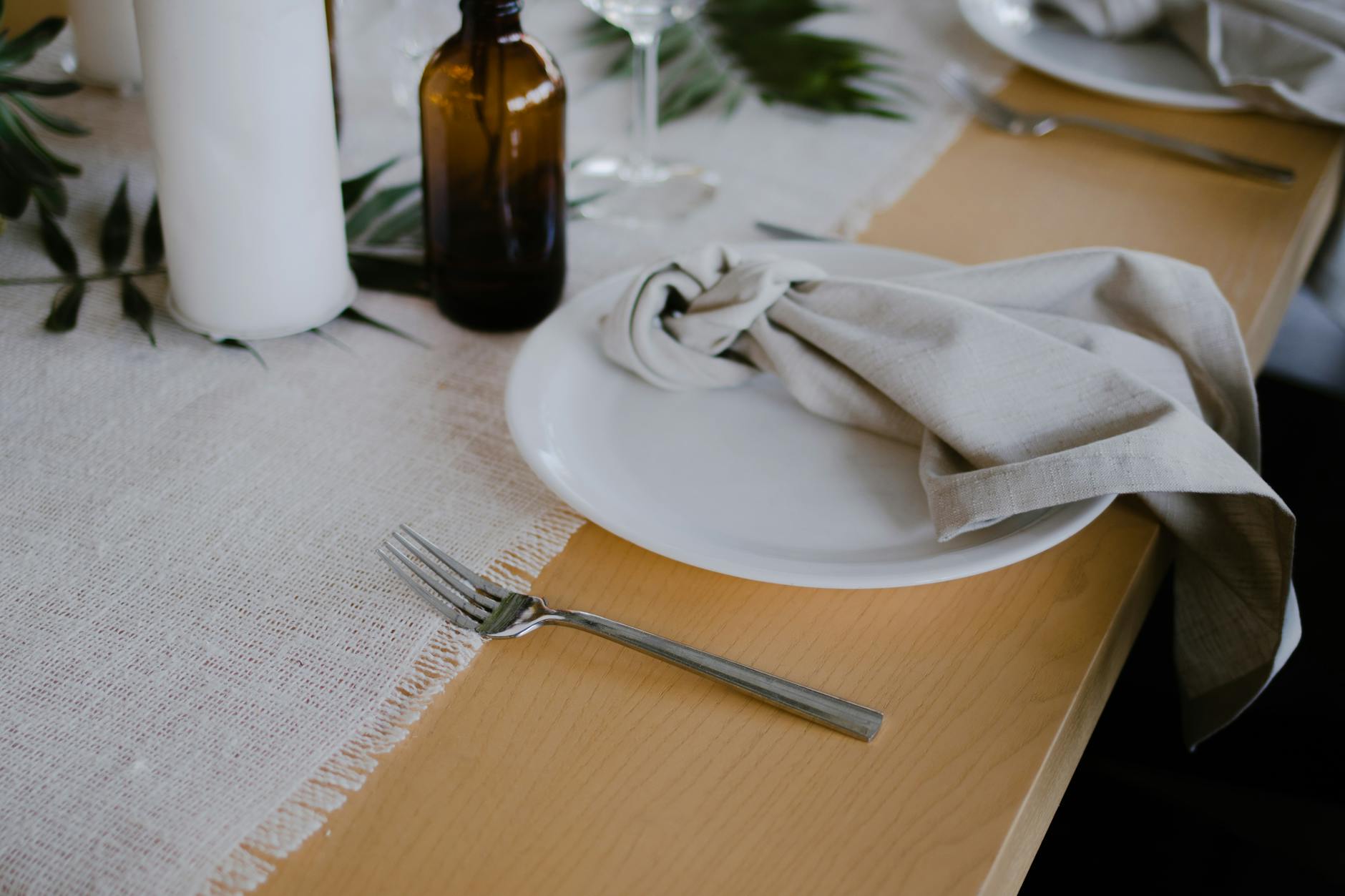
Instead of paper napkins, my husband and I use cloth napkins, an idea I picked up from my au pair host family in Spain. We own about ten cloth napkins and I wash them once a week, or more frequently if they are dirty. To keep track of whose is whose, you can use a different color or pattern for each person.
Item #5: Paper Plates
Growing up, my mom greatly appreciated the convenience of not having to wash up dishes after meals, so we mostly ate off of paper plates. My parents would buy the giant bag of flimsy paper plates from Costco, and I imagine that the cost of the plates was probably viewed as a small price to pay compared to time saved in washing dishes. However, I enjoy eating meals off of real dishes and I never personally purchase paper plates for my household. I find that washing plates actually takes very little time in addition to other dishes, as they generally just need a quick rinse and scrub. Plus, I feel like eating off of a real dish elevates a meal, no matter how simple it is. Paper plates can certainly come in handy, especially if feeding a large crowd, but for me the amount of time I spend to wash real plates is worth the trade off of money saved and waste avoided.
Item #6: Bottled Dish Soap
When I first moved out, I searched thoroughly to find dish soap that did not contain questionable ingredients and was environmentally friendly, as well as cost effective. I came to find that this was not in fact liquid soap but dish soap in the bar form. I typically use dish soap bars from either Mighty Nest or Meliora, as I actually know what’s in them. They come in a plastic-free compostable box, and they last way longer than a regular bottle of dish soap. It can certainly take a little adjusting to get used to using a soap bar for dishes instead of squeezing soap onto a sponge, but once you do you may come to prefer it as I have.
Item #7: Regular Sponges
Did you know that those scrubby-on-one-side-spongy-on-the-other dish sponges that most people have in their kitchens are made of plastic in a form that is basically impossible to recycle? Imagine how much waste the average household creates by using those; not to mention that they are often smelly and tend to break down and require replacing very quickly.
I ditched those average nasty sponges a long time ago, but I’ll be honest in saying I have not yet found a sponge that I love. I do use bamboo dish scrubbers, which last way longer than regular sponges, are naturally anti-bacterial, and are compostable; but I find that sometimes you just need the sort of scrubbing ability that a sponge offers. For that I like these natural loofah sponges or a Swedish dish cloths. I also occasionally use cotton knit rags, which work great alongside my bar of dish soap (These ones are super cute).
Item #8: Bottled Laundry Soap
Laundry soap is another item I did a deep dive into researching when I first got out on my own. I dislike most liquid laundry soap because they come in plastic bottles, they’re full of synthetic ingredients that I am not comfortable putting on my skin, and they are not very cost effective.
Instead, I prefer powdered laundry soap and oxygen brightener for my laundry. They are made with ingredients I know, come in low waste packaging, and last longer than liquid laundry detergent. Price wise, powdered laundry detergent is also a better value. My preferred brand for this is Meliora which you can find on Amazon or on Mighty Nest.
Item #9: Dryer Sheets
Rather than spending money on dryer sheets that are not environmentally friendly and contain questionable ingredients, I opt for the sustainable alternative of wool dryer balls. These help remove static, soften clothes, and lessen drying time naturally. You also should not need to purchase these again for several years after the initial purchase. I have had the same set of wool dryer balls for almost three years and they still work wonderfully.
Item #10: Cleaning Sprays and Solutions
There are multiple varieties of cleaning products for every type of cleaning job imaginable, and it can be challenging to know where to begin when looking for products with ingredients that are healthy for people and the environment. I don’t enjoy the idea of using chemicals that feel toxic to breathe or touch to clean my house. For this reason, I don’t buy cleaning solutions or products like Windex, bleach, comet, pine sol, or Clorox wipes.
Instead, I use vinegar and baking soda to clean just about everything in my home, and a few microfiber towels to achieve a streak free clean on windows and mirrors. This simplifies my cleaning routine and product storage tremendously, and I feel comfortable knowing that the items I use to clean my home are gentle enough they could be eaten without negative effect, but still powerful enough to keep my home clean.
Maybe some of these swaps are familiar to you, or maybe I’ve introduced you to some fresh alternatives. If you love having some of the items on this list and couldn’t imagine giving them up that’s all good. Each individual has to decide what works best for them and allows them to live in the most alignment with their values. We are constantly inundated with various items marketed to us as essential, and they may become just that. My main objective of this post is not to critique the type of dish soap you use, but rather to invite you to take a closer look at the things you are buying and using in your home. Are they helping you to live a lifestyle in alignment with your values? Are they truly essential? Do they lighten the weight of your mental load, or add to it? These are all important questions to ask yourself.
Have you found it important to do an overhaul of the things you buy? What is your relationship to habitual buying? I’d love to hear from you in the comments below.
Some links in this post are affiliate links and as an Amazon Associate I earn from qualifying purchases, at no extra cost to you.
 Simple Sustainable Sovereign
Share your thoughts